
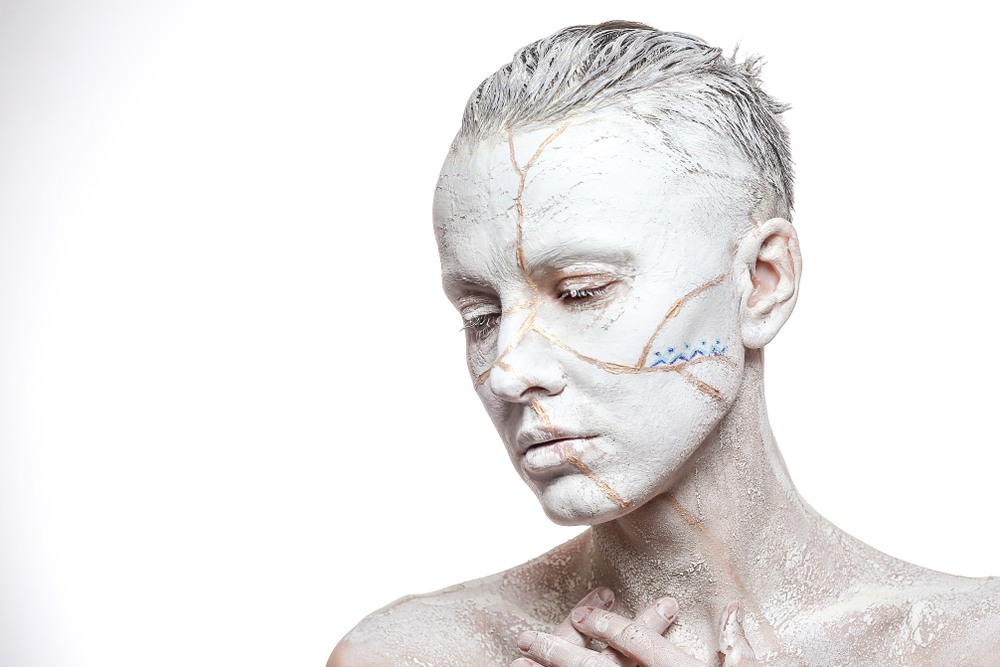
Scars have the strange power to remind us that our past is real.
My grandmother worried about the scars on my knees. No one seemed nearly as concerned about the ones we couldn’t see.
I was the kid who was always running around and falling, skinning my knees. My grandmother worried I would have unsightly, unladylike knees when I grew up. Every new scab seemed to confirm her suspicion that I was too wild. Too rough around the edges. As a child, I remember studying the fading marks and wondering if they would ever disappear. Looking back now, I find it interesting that so much attention was given to the scars on my knees and so little to the invisible ones we all carry. As children, we are taught to cover those imperfections deemed unacceptable. And later we realize we have covered the emotional ones too.
My grandmother imagined a future for me unblemished, as though the marks of my adventures might somehow diminish my appeal. I understand now that is where I learned how to hide.
I learned that being too sensitive was something to conceal. Being hurt, disappointed, scared, or heartbroken was best kept private. Physical scars eventually heal; the emotional ones are easier to cover. So I became the capable one, the strong one, the one who had it all together.
What I didn’t realize was that strength can sometimes become its own kind of scar when it is used to protect parts of ourselves that still need healing.
The scar is not the event; sometimes the scar is the adaptation.
I was rejected, so I learned not to ask
I was criticized, so I learned to stay small.
I was abandoned, so I learned to do everything myself.
Those emotional scars that shaped me weren’t always tied to a single event. Some developed quietly. They became behaviors, ways of being, strategies for belonging. I learned which parts of myself felt acceptable and which felt safer tucked away. When to speak and when to remain silent.
At the time, those adaptations served a purpose. They protected me. But years later, I realized those signposts pointed to places I needed to tend.
Do you remember your first emotional scar? Did anyone ever worry about the marks life might leave on your heart?
Or were those wounds expected to disappear with time, whether they healed or not?
We live in a culture that often treats damage as failure. If something breaks, it is replaced. If it cannot be restored to its original condition, we assume it has lost its value. We are surrounded by a mindset of newer, better, faster, where wear and tear is something to hide rather than acknowledge.
Yet life tells a different story.
Think about the first scratch on a brand-new car. At first, it is all you can see. You fixate on it, replaying how it happened. Eventually it becomes part of the landscape. The scratch remains, yet it no longer defines the whole.
There is a Japanese art form called kintsugi, often translated as golden repair. When a treasured piece of pottery breaks, it is not discarded. Instead, the cracks are carefully repaired with a lacquer dusted with gold or silver. Rather than concealing the damage, the repair illuminates it.
The result is something extraordinary.
The piece becomes more valuable not despite the cracks, but because of them.
The breaks become part of its story. The fractured pieces are joined together again, often stronger than before. What was once considered damage becomes evidence of resilience, transformation, and survival.
I have always loved the deeper meaning beneath Kintsugi. It proposes that brokenness is not the end of something. It is simply one chapter in its history.
Perhaps the same is true for us.
We all carry scars. Some are visible. Others exist beneath the surface, hidden in memories, disappointments, betrayals, losses, and moments that changed us forever. Whether we acknowledge them or not, they become a part of who we are.
Each of us is a collection of everything we have lived through. We are shaped by what was said to us, what happened to us, what we survived, and what we chose to believe along the way. Our experiences leave impressions, and those impressions become part of our unique design.
The goal is not to pretend the cracks never happened.
The goal is to recognize that healing does not require erasing the evidence of the pain. A scar is not proof that we were broken. It is proof that we healed.
I often think about the growing movement of tattoo artists who transform physical scars into works of art, incorporating them into designs rather than covering them up. It feels like a modern expression of kintsugi, an acknowledgment that what once hurt can become part of something beautiful.
What if we viewed all of our scars that way?
Not as defects to conceal, but as reminders of what we endured. Not as evidence of weakness, but of survival. Not something that diminished us, but something that deepened us?
Perhaps our scars are not parts of us that need redefining. Perhaps they have been telling the truth about our strength all along.
Out of suffering have emerged the strongest souls; the most massive characters are seared with scars.
~


Stephanie
Beautiful article
Marianne
Lovely ……thank you!
Marianne
Vale
This hits home Charisse, thanks for sharing <3
charisse
Thank you Valentina!
Linda Ballou
Writing The Cowgirl Jumped Over the Moon was my way of healing from an injury that took me out of the riding world. I wrote it standing up at my breakfast bar because sciatic pain would not let me sit. The process of living in my imagination for six months took my mind off the constant pain I was carrying. You were a part of that world that we both love. Thank you for reading and endorsing my novel. Publishing the book 20 years later has brought me back into the riding world in ways I hadn’t even considered. I just returned from a pack trip in British Columbia. What an adventure! So, thank you Charisse for being my friend. Linda
charisse
Thank you Linda! The pleasure is mine to have your inspiration as a writer, a world traveler and an amazing woman of courage!
Paola Silva
Beautiful! Thank you for sharing!
Beth Henkel
Wonderful food for thought. Thank you.
charisse
Thank you Beth.
alex
I’ve always loved kintsugi! perfect metaphor for this post. Loving the site!
charisse
Thank you Alex!
Conversations Start with Shutting Up | The Let Go
[…] is a Japanese technique called Kintsugi or Art of the Golden Repair. Once an item is broken instead of tossing it away, the crack or flaw is […]