Everything is energy, and that’s all there is. Match the frequency of the reality you want, and you cannot help but get that reality.
~ Attributed to Albert Einstein (widely shared in modern philosophy)
Entering your home or another’s means entering a vibrational frequency. For me, my home is my sanctuary. Just as words, actions, and intentions carry power and can affect relationships, they also affect a home’s vibration. And I protect my home as I would when I speak to another, and as I am spoken to. In doing so, I feel I am protecting my domestic nervous system.
I have only had raised voices in my home twice, as far as I can remember. Once, a friend and his brother were being loud and disrespectful to each other; I asked them to leave. The discord coursed through my body like an electrical current. That experience reinforced something I had sensed for years: homes absorb and reflect the emotional tone of those who live within them. Whether understood as energy, atmosphere, or simply the cumulative effect of daily interactions, a space’s quality influences how we feel inside it.
Many lifestyle practitioners believe these intentions develop an energetic field which influences your mood, focus, and personal growth.
Rather than seeing it as a place I reside in, I treat it as an active participant in my well-being.
I have adopted several habits to ensure my tranquility.
Some of these practices are inward and invisible. Others take the form of simple daily rituals that quietly shape the feeling of a home.
Speak to your home daily. Thank it for providing you with shelter, warmth, and security. Take care of it. Mend things when they need it. Respect your space by keeping it clean. We are its stewards, and that requires consciousness.
Many subscribe to a no-outside-shoes rule, leaving the day’s dirt outside. My home is one of them. The practice is much more than cleanliness; it is equally about energy. Leaving the travails of the day at the door is a symbolic boundary between the chaotic world and your environment of peace and harmony.
Removing your shoes is a ritual of decompression, quietly signaling to your body to relax. In traditions like Feng Shui, the door is the mouth of the building through which Chi enters. Our shoes carry with them everything they have come into contact with, from the sidewalks, roads, crowds, and offices. Simply removing them creates a clean energetic boundary.
Once we become aware of what we bring through the threshold, it is natural to become more conscious of what we choose to keep within it.
Everything within your home can uplift you or drain you, so be mindful of what you surround yourself with. Intentional spaces reduce the subconscious visual and mental chaos. When you pass something that may trigger an old or unwanted feeling, remove it so your nervous system can be refreshed.
The style of our homes, whether minimal or maximal, doesn’t affect the energy. It is deeper and more subtle than style.
Your home contains the thoughts and emotions that it is imbued with. It knows all. Your desires, your fears, your past, and present state of mind.
This understanding is not unique to any one culture or philosophy. Across centuries and continents, people have developed practices that honor the relationship between inner life and living space.
Many traditions hold significance to the energy of the home. Not one is superior to the other. Find what works for you. By doing so, our nervous systems relax, allowing our intuition and sensitivity to Earth’s rhythms to help and heal us safely.
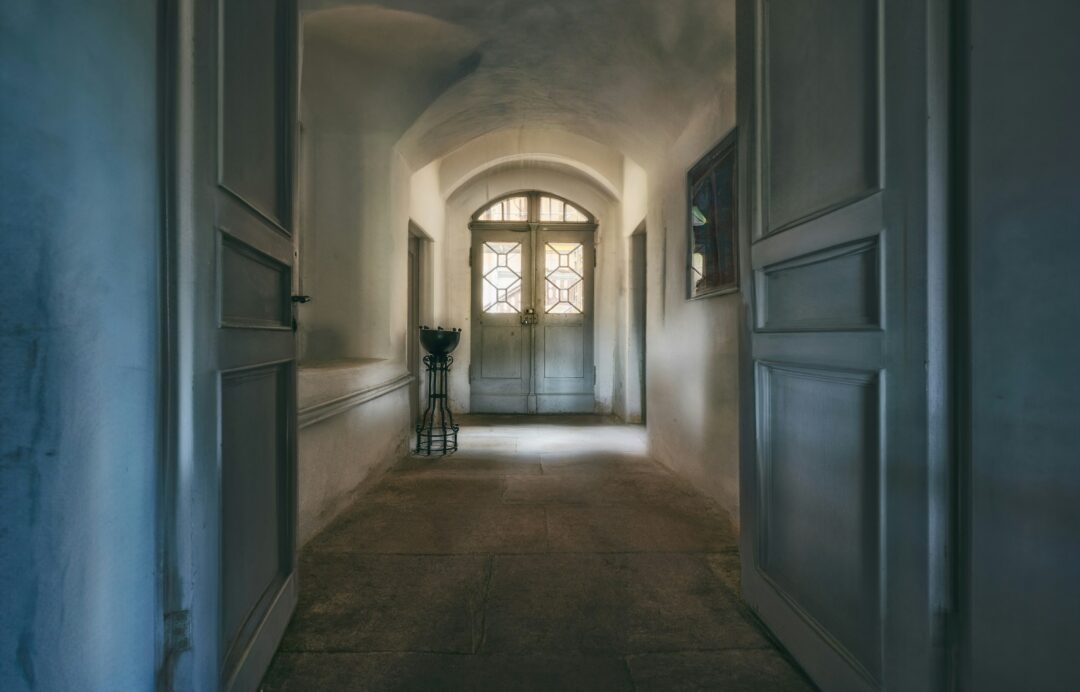
Each time we cross the threshold, we are not simply entering a structure. We are stepping into a relationship, one that reflects and shapes who we are becoming. The way we enter matters. The energy we bring matters. The care we offer returns to us in kind. Every threshold asks something of us. Not perfection, but presence. It is more than a doorway. It is a pause between worlds, an invitation to choose what enters with us and what remains behind.
A house is made with walls and beams; a home is built with love and dreams.
~ Ralph Waldo Emerson