To understand the horse, you’ll find that you’re going to have to work on yourself.
~ Ray Hunt
The phrase The Let Go is one I coined when I first began working with people learning to ride their horses. In training, a cue is given, and only when the pressure is released – The Let Go – does the horse process what is asked. The Let go is the reward for making the right choice.
What I didn’t realize at the beginning was that The Let Go wasn’t just for the horse. It was for me.
Whether I was working with a horse, with people, or with my own self-understanding, I kept meeting the same truth. The quality of my communication depended on the quality of my inner being.
Horses became the mirror that showed me where I tightened, where I pushed, where I clung to what I thought I knew. To reach the levels I desired, I had to let go of the stories, the postures, and the old ways of bracing against life. I had to become open to what wanted to reveal itself.
In Buddhism, there is a word called shenpa, which roughly translates to attachment. Pema Chödrön describes shenpa as the urge, the hook, that triggers our habitual tendency to close down.
I knew that hook. It lived in my body before I had a name for it. The tightening of my jaw, the crossing of my arms, the subtle withdrawal of my presence. Shenpa wasn’t just an idea; it was the moment my muscles clenched, my emotions shut the doors.
A tight muscle is rigid; a relaxed muscle is receptive. Once we close, nothing new can enter.
We cannot receive if we have already shut our ears, our minds barricaded, and our hearts shielded.
With my horses, this arrived without a word, and the clarity stopped me cold. They do not respond to who we pretend to be; they respond to who we are, the truth behind the posture. Willing conversations, whether with a horse or a human, require awareness and the discipline to keep that awareness open. Respect, softness, and clarity begin within. We cannot expect another being to give us something we cannot access ourselves
Much of what I learned about life, I learned from my horses and shenpa.
In my early years, I believed I needed to cowboy up, to show strength and dominance, and to have an “I’ll show you” attitude. At ten times my body weight, I quickly realized I needed to get smarter, not louder. This shift began a new conversation: How could I get a horse to do what I asked as simply and clearly as possible?
To build a relationship, I needed to learn to speak horse. I watched how they moved within a herd, how communication was mostly quiet: a flick of an ear, a sway of their body, or a subtle projection of energy. Their language was minimal but precise.
As I learned to be quiet within myself, I unlocked the ability to hear what was unspoken. In that quiet, something unexpected happened. My inner life rose to the surface.
My inner life, the parts I hid away from myself, my fears I tucked away, the frustrations I ignored, and the insecurities I masked. All became louder in the silence. The horse didn’t expose them to shame me; they exposed them so I could see what stood in the way of clarity. The biggest burden a horse carries is our expectations. It became clear to me that until I released them, my horse couldn’t either.
Quietness became a kind of walking meditation. It changed how I moved around the horses. I developed patience for them long before I found it for myself. Over time, it softened me; it made room for a gentleness, for curiosity, and for the possibility that I didn’t need to force anything, not with horses and now with myself.
This was my first clue to The Let Go. To move forward, I needed to understand myself, my agenda, my triggers, and my attachments. Shenpa taught me to let go of what no longer served my well-being. The Let Go wasn’t just about releasing pressure on the horse; it was a release of pressure inside of me.
At first, recognition feels complicated. We set our expectations and want results immediately. But letting go begins by putting aside those things too, our anticipations, our opinions, and our preconceived stories. How long should it take? What should it look like? Letting go means allowing what needs to unfold to unfold. When we remove the plan, the horse feels it. They relax, and the same is true for all relationships. Letting go of attachment to the outcome makes room for what is necessary.
When we begin to notice the slightest changes, our vision shifts. As we see differently, endless possibilities expand. Yet once we see a simple change, we must resist the urge to get greedy, wanting it finished, perfected, wrapped in a bow. Shenpa teaches us to let go of the result.
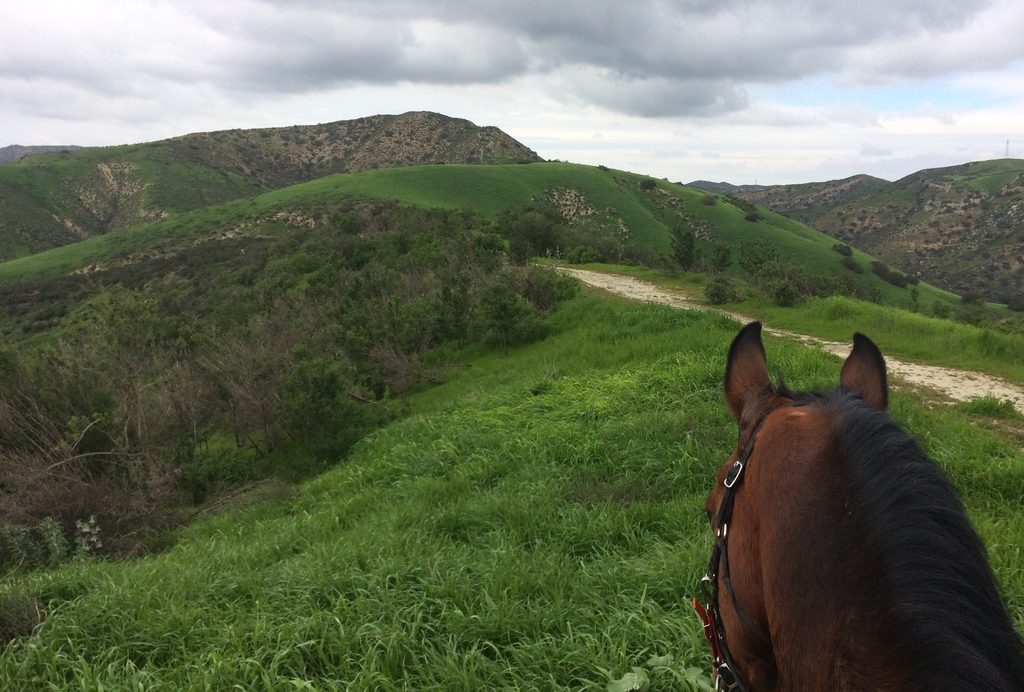
So, take the time. Be clear in what you’re asking for. Trust the baby steps are still forward. Even if you pause to enjoy the vista, what needs to happen will happen exactly when it’s meant to.
Every let go I’ve ever given — to a horse, to an old story, to myself — has made room for something better to arrive.
~Charisse Glenn